Tuesday, April 24, 2012

Good morning, little bees!


This image was captured on the webcam this morning at 9:45am.  It was overcast, about 54oF, so the bees are sitting at the nest entrances waiting for the sun, or for the temperatures to warm up enough to fly.   Most of them are males; you can see the yellow spot on their faces.  They are using the tunnels as shelter for the night, but they do not make a nest like the females. Note the bee sitting on top of the emergence box.

Sunday, April 22, 2012

Webcam is online! Orchard Bees are emerging!

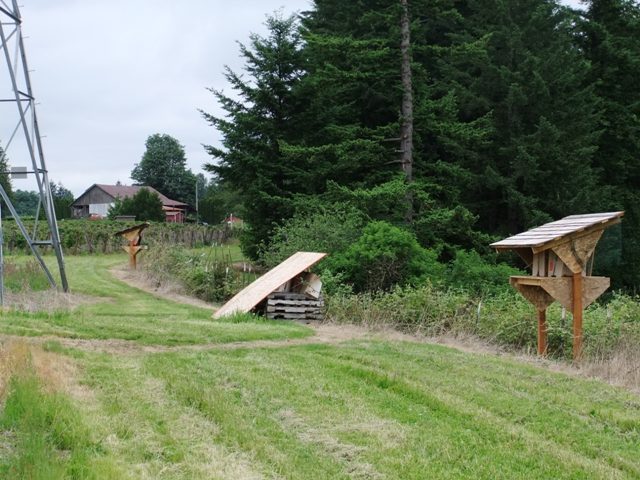
Bee shelter in Sturm field, April 22, 2012
The Oregon Berry Bee WebCam (on the Sturm Berry Farm in Corbett, OR) has been live for a couple of weeks, but with some wet and cool weather nothing has been in bloom.  Now the weather is warming, and it’s looking like the blueberry will bloom soon.  Rosie Sturm put out two emergence containers of the blue orchard bee, Osmia lignaria in the shelter at the webcam site this morning.  The bees should be emerging over the next week or so, and hopefully will find enough to forage from and start nests. 

We are particularly interested to know if they help with blueberry pollination, and if they are still around when the black raspberry comes into bloom.  Have a look at the webcam and let us know what you see.

The camera image is on between 7:30am and 7pm Pacific time.  It is shut off at night to conserve battery charge, which relies on a solar panel.

If you would like to know how to connect to the webcam, contact me and I'll e-mail you the connection information. 


Black raspberry preset on April 22, 2012
Once you log on, there are preset camera views (nests, raspberries, blueberries) that you can go to from a menu at the top of the image.  You can also zoom, pan and tilt the camera with the controls under the image.  Be patient, the controls are slow because they are being transmitted over a cell phone line.  Click once, and wait for a few seconds to see the movement.  If the camera gets too many commands at once it stops reacting.

Wide view of black raspberry on April 22, 2012
There is also a large dial thermometer in the bee shelter.  You can zoom in to see what the temperature is.  

 Osmia aglaia, the Oregon Berry Bee, emerges later in the season than O. lignaria, so Rosie is holding on to the cocoons and nests until the black raspberry starts to bloom.  Watch for a post when the O. aglaia are released.

All of the photos posted here are preset views from the webcam.

East view of blueberry field on April 22, 2012


Please share the website and guest login information with anyone who you think might be interested in watching the bees and the flowering phenology along with us.

Monday, December 12, 2011

Cleaning Bees, Nov. 20, 2011

We visited the Sturm Farms on November 20, 2011 to remove the bees from their nests and prepare them for the winter. This year we expected to clean lots of nests, so Jerry brought three cleaning machines. Jerry (far left), and John (far right) spent most of the day cleaning nests. In the morning, Rosie (center) also helped on the middle machine. Eric Mader from the Xerces Society joined us to see how it's done. In the afternoon, Mike, the project engineer, visited, and Glen (center) manned the machine.


In the 2011 season we were interested in increasing Osmia lignaria populations as well as O. aglaia, and that created a problem for cleaning out the bees. Although the two bees typically use different diameter nesting holes, apparently many of the O. lignaria were small enough to nest in the O. aglaia Binderboard. That presented a problem cleaning the bees, because we wash the O. lignaria cocoons to remove dirt and other debris and to wash off mites, whereas we don't wash O. aglaia cocoons. There was also a risk that if the bees nest together, mites will transfer to O. aglaia cocoons. We haven't seen mites on O. aglaia before.

We saw few if any mites on the O. lignaria nests, and didn't see any on O. aglaia. There were only a few Binderboard that had nests of both species. However, there were quite a few O. lignaria cocoons infected with Monodontomerus parasitic wasps. I removed as many as I could identify from the washed cocoons. Our final yield of O. lignaria was only 1.25 cups of cocoons with about 236 females per cup. Females were 35% of the cocoons. That means our total yield of females was about 300, enough to pollinate an acre of fruit trees, in theory. Compare that with a yield of 420 females from Sturm farms in 2010 that were released in spring 2011. To that we added about 90 additional females from other sources in Portland. That means our yield was about 58% of last year's yield. Not good.

The O. aglaia did not fare much better. Last season we removed about 31 cups of cocoons from the nests, with and estimated 21,700 bees. We did not try to estimate sex ratio. This year our total yield was about 10.3 cups, with about 650 cocoons per cup. That's only 6,700 cocoons total, 31% of last year's yield. Many of those cocoons had larvae in them that had not fully developed into adults. That suggests that the summer was not warm enough for the bees to complete development. We had the Sturms leave the cocoons in their garage for a month or so, in hopes that the temperatures would be warmer than on the porch where the cocoons have overwintered in the past. Hopefully more of the cocoons will complete development.
Why such a poor bee yield in the 2011 season. Certainly the cold, wet, late season must have had an impact. But perhaps the high numbers of honey bees also had an impact. There may not have been enough pollen for everyone.

Don says that the berry yields suffered from disease this past season, but the black raspberry had good pollination. Perhaps the presence of our managed native bees had a positive impact on the pollination, even if they did not reproduce as well as we would like.


Monday, July 4, 2011

Black Raspberry Bloom, 2011 Part 5

The morning of June 17 was sunny, and the Osmia aglaia finally came out of their emergence containers and started foraging, mating, and searching for nests. In previous posts I've discussed their foraging on black raspberries and other flowers in the sturm fields. As temperatures warmed, there was lots of activity in the shelter. It's impossible to capture a sense of that activity in a still shot, but perhaps you can get an idea from this photo showing bees checking out empty tunnels in the webcam shelter. Three were crawling around on the bottom board, and click on the image to see bees in tunnels on the upper board.
The bees spent quite a bit of time sunning on the ground around the shelter; I even saw some sunning amongst the blueberry plants.

Here's an O. aglaia couple mating on a black raspberry leaf. Usually mating takes place early in the life of the bees, so this is further evidence that the O. aglaia had probably not yet started nesting.


We added some additional Binderboard nests to the shelters before we left. Here's the webcam shelter on June 17 after adding the additional nests. Before we left we put the lids back on the emergence containers and moved them to the sides of the shelter.


We also added more Binderboard nests to the Marion Berry shelter before we left.


One last thing that I should mention. After taking one last ride around the farm to see if there was any O. aglaia activity yet at Jim Cane's shelters (none seen) we saw Don's beekeeper setting up more honey bee hives just east of our marion berry shelter. There were 10 hives with a total of 24 supers. This makes a total of 29 honey bee hives in Don's fields. That's a large number. It will be interesting to find out if they have impact on our O. aglaia reproduction this season.


Black Raspberry Bloom, 2011 Part 4

Eric Mader from the Xerces Society in Portland, OR, contacted me in May. He explained that "Xerces has some funding (through a national NRCS grant) to work with various specialty crop producers in different regions of the country to develop bee habitat on their farms. For the most part this consists of restoring native flowering plants that compliment crop bloom times by providing additional pollen and nectar resources.
"We have some additional funds to field test this same strategy with a berry grower here in western Oregon and Washington, and I wanted to check with you to see if this might be a useful opportunity to compliment your existing Osmia aglaia project?"

Naturally, I suggested that the Sturm Farm might be interested in participating, but it wasn't until my visit to the Sturm Farm in June that I was able to arrange for Don and Eric to meet. Fortunately Eric was available on short notice to come out to Corbett the afternoon of June 16.
It turns out that Don already has an NRCS grant for wildlife plantings, so the Xerces grant will supplement it and provide some guidance on the most suitable bee-friendly plants. Don had a meeting at 1pm that afternoon with the local NRCS representative, and then he hurried back to the farm to meet Eric at 3pm. Eric showed up with another Xerces staff member, plant ecologist Brianna Borders. By then the clouds had cleared and the sun was out. Don loaded us into his truck for a quick tour of his 140 acres of berries, including all of the O. aglaia shelters.
Here we are at Jim Cane's central bee shelter near the marion berries. Don is on the right in white shirt; Eric is in the center with Brianna behind him, and my husband John is on the left. Notice that we moved the bee nests from the pallets on the right to the new wood shelter. If the bees had been active this would not have been a good idea, because they would not have found the new nest location. But since the bees were not yet active, it was a good time for the move.
Don and Eric decided that this location would be the best place on the farm for bee-friendly plantings. It's central location will make it accessible to bees from other parts of the farm, and this open area will be easy to cultivate. in preparation for planting.
In addition to checking out the nest sites for O. aglaia, we spent a little time seeing who was visiting the black raspberry. There seemed to be far fewer bumble bees in the afternoon than in the morning, when it was overcast and cold. I had collected a few of the bumble bees that I saw in the morning, and Eric identified the more common species as either Bombus melanopygus or mixta, and the less common species as B. vosnesenskii (see photo of this species in Part 2 of the posts on black raspberry bloom).

We also noticed a neat hole at the end of a prunned raspberry cane. Eric used his pen knife to slit the cane open, and there we found a couple of Ceratina sp., the small carpenter bee. This genus makes it's nest by burrowing into pithy stems such as Rubus canes and dead common mullein stems. One has to cut the stems so the pith is accessible to the bees. After creating a nest with a series of offspring cells in the stem, the mother Ceratina bee guards the entrance of the nest and periodically checks on her developing offspring, according to a thesis from University of Georgia in the 1970s. There were two bees in this tunnel, and not much of a nest, so I suspect that these bees were just beginning to nest. Don says that he leaves the prunned canes in the black raspberry but not other berry varieties. I recommended that he cut the brown stems of last year's common mullein stalks that are found around the edge of the farm so there are more nesting sites for Ceratina. There are some in the Himalayan blackberry patch where Jim Cane's mail tote shelters are located. Ceratina is probably a good raspberry pollinator, and it would be great to increase their populations.
Hopefully Eric and Don are moving forward on this project. Maybe we can get some photos of the site as it is planted on this blog. Eric is also hoping that we can have a farm field day next spring to showcase the bee plantings and alternative bees.

Sunday, July 3, 2011

Black Raspberry Bloom, 2011 Part 3

As discussed in the two previous posts, our shelters had quite a bit of activity of both Osmia lignaria and Osmia aglaia, especially on the sunny morning of June 17. Meanwhile, Dr. Jim Cane from the USDA ARS Bee Labs in Logan, UT, had introduced quite a few of his O. aglaia in different parts of the berry fields. What was happening in them?


One of Jim's shelters is located in the center of the berry fields, close to our central shelter near the marion berries. When we first checked it out, the bee nests were in cardboard boxes sitting on a stack of pallets with a board as a roof on top. Next to the nests was a new shelter that Don's father built. Don hadn't yet had time to move the nests. We did not see any bee activity at this shelter.


Last year all of Jim's bees were released in the southwest corner of Don's field, next to a large patch of Himalayan blackberry (see last year's posts). They were released in several of Jim's mail tote shelters. This year three mail tote shelters are back, flanked on either side by one of Don's dad's wood shelters. The first photo shows the shelters from the west end looking east, the second photo shows the shelters at the east end looking west. The straws with bees are all in the wood shelters. We saw no O. aglaia activity in these shelters, but we did see a couple of O. lignaria working on nests in the wood shelter in the farthest southeast corner (first photo). As of June 17, the Himalayan blackberry had lots of buds but no bloom.


The last set of shelters is also at the west end of the farm, but further north, across a wide valley full of Himalayan blackberry. There are some commercial berries in this field, as well as Don's Christmas trees. At this site there are two of Don's dad's wooden shelters, as well as a shelter consisting of cardboard boxes on pallets with a roof on top.


Here's the view from the center shelter, looking over the valley that is totally covered in Himalayan blackberry. No one walks into that thicket. Across the valley you can see the power lines where Don's main fields are located. The white line next to a spruce tree to the right of center is the honey bee hives shown in the previous post. These photos were taken on the morning of June 16 when it was still overcast and cold.


This and the next photo were taken on the morning of June 17 when the sun was out, and there was lots of O. aglaia activity in our shelters. However, there was very little activity in Jim's shelters. If there had been, sunning bees would have been visible on the floor of the shelter.


No activity seen in a close up of the emergence box of filled nests on the left, or in the bee boards on the right.


We did see O. lignaria in this third set of shelters. Some of the bees were hiding under the wood shingles of the roof. One is seen in the center of the first photo. Can you see the two in the second photo? They look superficially like flies, but they are O. lignaria. One is on the board on the right, the other seen from the side, between the boards.

Wednesday, June 29, 2011

Black Raspberry Bloom, 2011 Part 2


In this post I'll address these questions:

-Does O. aglaia forage from black raspberry?
-What other bees forage from black raspberry?
-What other flowers does O. aglaia visit, and what else was available to them on the Sturm farm?

Notice that I won't say what's pollinating the raspberry leading to mature fruit. In many cases when bees visit a flower, they pollinate it, but not always. The only way to be sure would be to carefully control the visits that a flower gets by particular bee species, and then to follow the flower through fruit development.

When the sun poked tentatively through the clouds on the morning of June 16, the first foraging O. aglaia that we saw were visiting white clover and dandelion. These were the closest flowers to the webcam shelter. The O. aglaia seemed to be taking nectar but not pollen.


Sorry about the blurry image. It documents that O. aglaia foraged from dandelion. (Actually, on second thought this looks like it might be Agapostemon or Augochlora! - July 20)


When the afternoon turned sunny, we saw O. aglaia on the black raspberry flowers! They move rapidly, so they are hard to photograph on the flowers, but I managed to get a few photos of the foraging females. The first female is visiting a bud that is just starting to open.


I'm pretty sure that's a nectar visit. According to McGregor (Insect Pollination of Cultivated Crop Plants, Agriculture Handbook No. 496, 1976): "When the flower opens, the anthers are immature, with the filaments bent over the immature styles. Subsequently, the outer stamens bend back toward the petals and their anthers dehisce. As dehiscence progresses toward the center of the flower, the receptacle expands, the styles grow, and the receptive stigmas appear at their tips; later, the anthers nearest the stigmas dehisce, and, if cross-pollination has not already been brought about by insects, some selfing may result. The degree of such selfing seems to vary with species and cultivar, but most of them are largely self-sterile."


It's hard to be sure from this photo, but it is possible that there is a little pollen on the underside of the abdomen of this bee. We looked hard to try to determine if there was pollen in the scopae of bees returning to the nests, but did not see any either on foraging bees or on bees returning to the nests. I suspect that the O. aglaia were just beginning to search for nesting sites at this time.


A variety of other weeds were available in the area around our bee shelters, but none as abundant as white clover and dandelion. In addition, there were two crop species near the webcam shelter. South of the shelter was a small strawberry patch with blooms as well as immature and ripe berries. Just east of the strawberries were some blueberry plants in bloom. See the earlier post about bee introduction in May. On June 17, a sunny day, I saw few bees visiting the blueberry: especially compared with raspberry visitation. There were a few bumble bees. I saw some O. aglaia sunning on the ground in the blueberry patch, and I'm pretty sure that a couple of them flew up to the blueberry flowers, but I didn't get a good look at them.


Here's a photo from the west side of the Sturm fields. The white shapes on the left are honey bee hives.


Don doesn't pay anything to get honeybees in his berry fields. Rather, he works with a beekeeper who is happy to bring hives to Don's field because of the absence of insecticide sprays. On June 16 I counted 19 hives with a total of 50 supers in this row near the west end of the fields. Then on June 17, the beekeeper added 24 more supers in 10 hives closer to the marion berries where our second Osmia shelter is located. I hope that's all that were brought to the field. The honey bees are likely to have an impact on the growth of the O. aglaia population.


Bombus vosnesenskii is one of the species of bumblebees foraging on the black raspberry.
She is apparently only taking nectar, because there does not appear to be any pollen on the corbicula of her hind leg.


In addition to the honey bees and bumble bees, we observed a few ground nesting bees foraging on the black raspberry on June 17. The morning was sunny, though the temperature was only 55oF. These included some small Lasioglossum (Dialictus), and possibly an Andrena.
Visitors to the black raspberry seemed to change with the weather. The morning of June 16 there seemed to be equal numbers of honey bees and bumblebees in the cool, overcast weather. That afternoon when the sun came out the bumble bees became much less abundant.
We decided to quantify the numbers. At 5:45pm John and I each counted bee visits to 6 inflorescences of black raspberry close to the webcam shelter for 15 minutes. The temperature was 65oF, and the sky was overcast. John counted 10 honey bee visits and one visit by a Lassioglossum or Andrena (on 11 young open flowers, 41 total flowers in 6 inflorescences). On a different patch of 6 inflorescences I counted 19 honey bee visits (on 10 young open flowers, 73 total flowers in 6 inflorescences).
We repeated the counts on the morning of June 17. The temperature was 55oF, the sky was sunny. We started our 15 minute counts at 10:17am. John counted 23 honey bee visits, 2 O. aglaia visits, 2 Lasioglossum and 1 fly visit (on 10 young open flowers, 49 total flowers in 6 inflorescences). I counted 27 honey bee visits, 12 O. aglaia visits, and 6 Lasioglossum visits (on 17 young open flowers, 38 total flowers in 6 inflorescences). . We saw a few bumble bees, but bumble bees were much less abundant than they had been on the cold morning, and they did not show up in our counts.

One mystery that we never solved: What were the Osmia lignaria visiting? They were active at the shelter, even in the cold June 16 morning. They seemed to fly toward the blueberries, but I did not see them foraging on blueberries or raspberries. The nearby maple trees had developing fruit, so they were not attracting bees. So, it's not clear if the blue orchard bee was contributing to pollination of any berries.